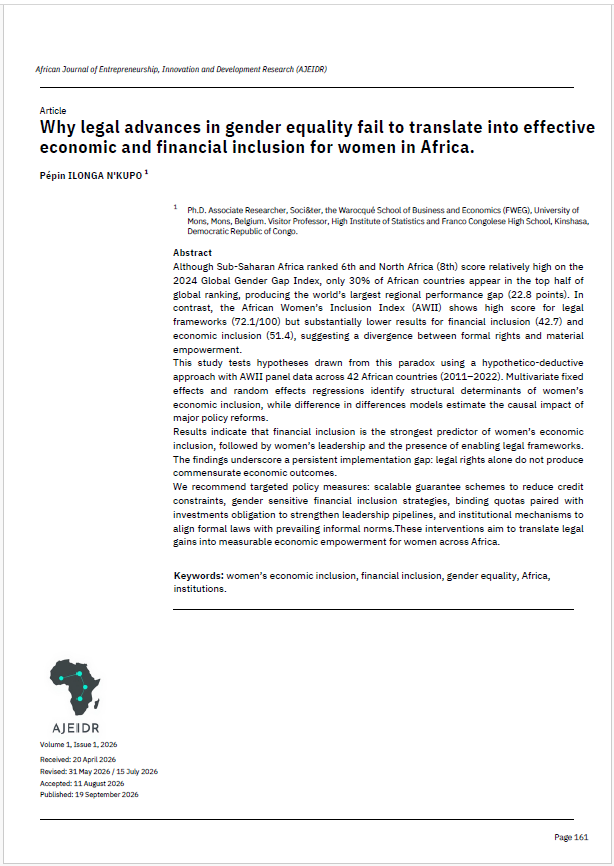
Why legal advances in gender equality fail to translate into effective economic and financial inclusion for women in Africa
Keywords:
Women’s Economic Inclusion, Financial Inclusion, Gender Equality, Africa, InstitutionsAbstract
Although Sub-Saharan Africa ranked 6th and North Africa (8th) scored relatively high on the 2024 Global Gender Gap Index, only 30% of African countries appear in the top half of the global ranking, producing the world’s largest regional performance gap (22.8 points). In contrast, the African Women’s Inclusion Index (AWII) shows a high score for legal frameworks (72.1/100) but substantially lower results for financial inclusion (42.7) and economic inclusion (51.4), suggesting a divergence between formal rights and material empowerment. This study tests hypotheses drawn from this paradox using a hypothetico-deductive approach with AWII panel data across 42 African countries (2011–2022). Multivariate fixed effects and random effects regressions identify structural determinants of women’s economic inclusion, while difference-in-differences models estimate the causal impact of major policy reforms.
Results indicate that financial inclusion is the strongest predictor of women’s economic inclusion, followed by women’s leadership and the presence of enabling legal frameworks. The findings underscore a persistent implementation gap: legal rights alone do not produce commensurate economic outcomes. We recommend targeted policy measures: scalable guarantee schemes to reduce credit constraints, gender-sensitive financial inclusion strategies, binding quotas paired with investment obligations to strengthen leadership pipelines, and institutional mechanisms to align formal laws with prevailing informal norms. These interventions aim to translate legal gains into measurable economic empowerment for women across Africa.
References
Acemoglu, D., & Robinson, J. A. (2012). Why nations fail: The origins of power, prosperity, and poverty. Crown Publishers.
ACET. (2025). The African Women’s Inclusion Index 2025: Charting progress on financial and economic inclusion. African Centre for Economic Transformation.
African Development Bank. (2020). African Gender Equality Index 2020. AfDB.
African Union. (2020). Report on the implementation of the African Women’s Decade 2010‑2020. African Union.
African Development Bank. (2025). African Women’s Inclusion Index (AWII) report 2025. African Development Bank.
Alesina, A., Giuliano, P., & Nunn, N. (2013). On the origins of gender roles: Women and the plough. Quarterly Journal of
Economics, 128(2), 469‑530. https://doi.org/10.1093/qje/qjt005
Allen, F., Demirgüç‑Kunt, A., Klapper, L., & Peria, M. S. M. (2016). The foundations of financial inclusion: Understanding ownership and use of formal accounts. Journal of Financial Intermediation, 27, 1‑30. https://doi.org/10.1016/j.jfi.2015.03.002
Alliance for Financial Inclusion. (2023). The role regulators can play in closing the financial inclusion gender gap: A case study of Uganda. AFI.
Angrist, J. D., & Pischke, J.-S. (2019). Mostly harmless econometrics: An empiricist’s companion (2nd ed.). Princeton University Press.
Ashraf, N., Karlan, D., & Yin, W. (2010). Female empowerment: Impact of a commitment savings product in the Philippines. World Development, 38(3), 333‑344.
Aterido, R., Beck, T., & Iacovone, L. (2019). Access to finance in Sub‑Saharan Africa: Is there a gender gap? Journal of African Economies, 28(3), 332–365.https://doi.org/10.1016/j.worlddev.2009.05.010
Beaman, L., Duflo, E., Pande, R., & Topalova, P. (2012). Female leadership raises aspirations and educational attainment for girls: A policy experiment in India. Science, 335(6068), 582‑586. https://doi.org/10.1126/science.1212382
Bell, M., & Fernandez, P. (2024). Gendered institutions and economic inclusion: A systematic review. World Development Perspectives, 26, 100472.
Blattman, C., & Annan, J. (2018). Harnessing causal inference techniques in African policy contexts. Journal of Development Economics, 132, 1–19.
Brown, R. P. C., & Almazan, O. (2020). Financial inclusion and women’s entrepreneurship in Africa: Evidence from firm‑level data. World Development, 127, 104754.
Chamlou, N., Gaddis, I., & Morsy, H. (2019). The gender dimensions of informality in Africa: Evidence and policy options. World Bank Policy Research Working Paper.
Chattopadhyay, R., & Duflo, E. (2004). Women as policymakers: Evidence from a randomised policy experiment in India. Econometrica, 72(5), 1409‑1443. https://doi.org/10.1111/j.1468-0262.2004.00539.x
Clayton, A., & Zetterberg, P. (2018). Quota shocks: Electoral gender quotas and government spending priorities internationally. Journal of Politics, 80(3), 916‑932. https://doi.org/10.1086/697251
Dahlerup, D. (1988). From a small to a large minority: Women in Scandinavian politics. Scandinavian Political Studies, 11(4), 275‑298. https://doi.org/10.1111/j.1467-9477.1988.tb00372.x
Dancer, H. (2015). Women, land and justice in Tanzania. James Currey.
Demirgüç‑Kunt, A., Klapper, L., Singer, D., Ansar, S., & Hess, J. (2022). The Global Findex Database 2021: Financial inclusion, digital payments, and resilience in the age of COVID‑19. World Bank.
Demirgüç‑Kunt, A., Klapper, L., Singer, D., & Ansar, S. (2022). The Global Findex Database 2021: Financial inclusion, digital payments, and resilience in the age of COVID‑19. World Bank. https://doi.org/10.1596/978-1-4648-1897-4
D’espallier, B., Guérin, I., & Mersland, R. (2011). Women and repayment in: A global analysis. World Development, 39(5), 758‑772. https://doi.org/10.1016/j.worlddev.2010.10.008
Ellen Johnson Sirleaf Presidential Centre for Women and Development. (2022). Women’s political leadership in Africa. EJS Center.
Fletschner, D., & Kenney, L. (2014). Rural women’s access to financial services:
Credit, savings, and insurance. In A. R. Quisumbing, R. Meinzen‑Dick, T. L. Raney, A. Croppenstedt, J. A. Behrman, & A.
Peterman (Eds.), Gender in agriculture (pp. 187‑208). Springer. https://doi.org/10.1007/978-94-017-8616-4_8
Franceschet, S., Krook, M. L., & Piscopo, J. M. (2018). The impact of gender quotas. Annual Review of Political Science, 21, 167–185.
Goetz, A. M., & Jenkins, R. (2018). Feminist activism and the politics of reform: When and why do states respond to demands for gender equality? UN Women Discussion Paper.
GSMA. (2023). The mobile gender gap report 2023. GSMA.
Hall, P. A., & Soskice, D. (2001). Varieties of capitalism: The institutional foundations of comparative advantage. Oxford University Press. https://doi.org/10.1093/0199247757.001.0001
Hallward‑Driemeier, M., Hasan, T., & Rusu, A. B. (2013). Women’s legal rights over 50 years: Progress, stagnation or regression? (World Bank Policy Research Working Paper No. 6616). World Bank. https://doi.org/10.1596/1813-9450-6616
Harper, E. (2011). Customary justice: From program design to impact evaluation. International Development Law Organisation.
International Labour Organisation. (2019). Women in business and management: The business case for change. ILO. https://doi.org/10.54394/BPCM1234
Kabeer, N. (2022). Gender, money and rights: Lessons from Uganda and beyond. Development and Change, 53(2), 311–335.
Karlan, D., Ratan, A. L., & Zinman, J. (2014). Savings by and for the poor: A research review and agenda. Review of Income and Wealth, 60(1), 36‑78. https://doi.org/10.1111/roiw.12101
Kayuni, H. M., & Chikadza, K. F. (2016). The gatekeepers: Political participation of women in Malawi. CMI Brief, 15(12). https://www.cmi.no/publications/6062
Kouamé, A. (2023). Gender policy reversals in North Africa: Algeria and the politics of reform rollbacks. Review of African Political Economy, 50(176), 200–219.
Logan, C., & Besigye, C. (2021). Women’s political participation in Africa: What do the data say? Afrobarometer Policy Paper.https://www.afrobarometer.org/publication/pp58-womens-political-participation-africa/
Lusimbo, A., & Mutai, N. (2021). Financial literacy and women’s economic empowerment in Kenya. Kenya Bankers Association Working Paper.
Mackay, F., Kenny, M., & Chappell, L. (2010). New institutionalism through a gender lens: Towards a feminist institutionalism? International Political Science Review, 31(5), 573‑588. https://doi.org/10.1177/0192512110382028
Mbiti, I., & Weil, D. (2020). Mobile money adoption and women’s economic outcomes in East Africa. Economic Journal, 130(631), 85–112.
North, D. C. (1990). Institutions, institutional change and economic performance. Cambridge University Press. https://doi.org/10.1017/CBO9780511808678
Pitkin, H. F. (1967). The concept of representation. University of California Press.
Strasser, S., & Rijken, A. (2023). Institutional barriers to women’s economic empowerment in Africa: A meta-analysis. Journal of Development Studies, 59(8), 1350–1374.
Suri, T., & Jack, W. (2016). The long‑run poverty and gender impacts of mobile money. Science, 354(6317), 1288‑1292. https://doi.org/10.1126/science.aah5309
Tripp, A. M., & Kang, A. (2008). The global impact of quotas: On the fast track to increased female legislative representation. Comparative Political Studies, 41(3), 338‑361. https://doi.org/10.1177/0010414006297342
Waylen, G. (2015). Engendering the ‘crisis of democracy’: Institutions, representation and participation. Government and Opposition, 50(3), 495‑520. https://doi.org/10.1017/gov.2015.7
World Economic Forum. (2024). Global Gender Gap Report 2024. World Economic Forum
World Bank. (2019). Violence against women and girls: Lessons from South Asia.
World Bank. https://doi.org/10.1596/978-1-4648-1324-5
World Bank. (2021). Women, business and the law 2021. World Bank. https://doi.org/10.1596/978-1-4648-1660-4
Downloads
Published
Issue
Section
License
Copyright (c) 2026 Chefor Ngwenyi Meungwe, Nyakito Edward Alolo (Author)

This work is licensed under a Creative Commons Attribution 4.0 International License.