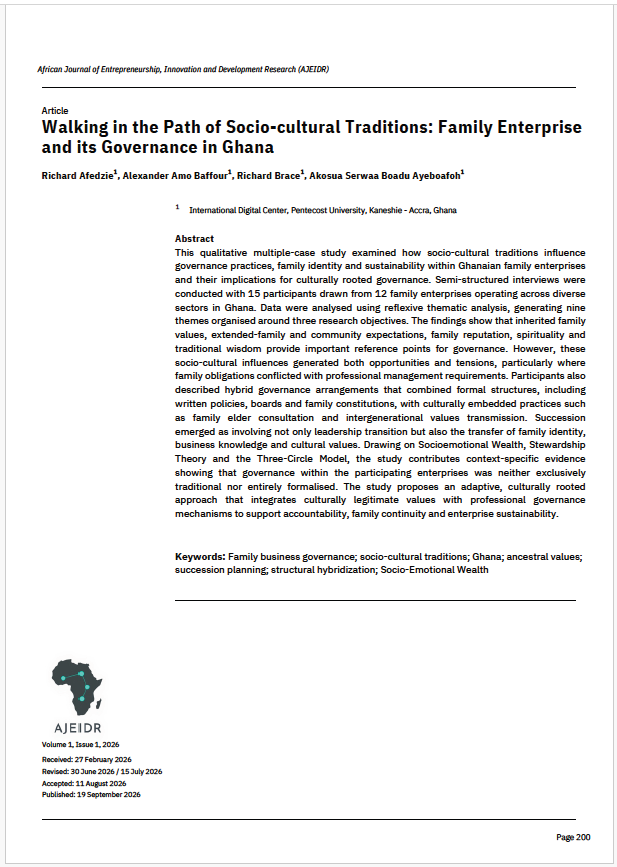
Walking in the Path of Socio-cultural Traditions: Family Enterprise and its Governance in Ghana
Keywords:
Family Business Governance, Socio-cultural Traditions, Ghana, Ancestral Values, Succession Planning, Structural Hybridization, Socio-Emotional WealthAbstract
This qualitative multiple-case study examined how socio-cultural traditions influence governance practices, family identity and sustainability within Ghanaian family enterprises and their implications for culturally rooted governance. Semi-structured interviews were conducted with 15 participants drawn from 12 family enterprises operating across diverse sectors in Ghana. Data were analysed using reflexive thematic analysis, generating nine themes organised around three research objectives. The findings show that inherited family values, extended-family and community expectations, family reputation, spirituality and traditional wisdom provide important reference points for governance. However, these socio-cultural influences generated both opportunities and tensions, particularly where family obligations conflicted with professional management requirements. Participants also described hybrid governance arrangements that combined formal structures, including written policies, boards and family constitutions, with culturally embedded practices such as family elder consultation and intergenerational values transmission. Succession emerged as involving not only leadership transition but also the transfer of family identity, business knowledge and cultural values. Drawing on Socioemotional Wealth, Stewardship Theory and the Three-Circle Model, the study contributes context-specific evidence showing that governance within the participating enterprises was neither exclusively traditional nor entirely formalised. The study proposes an adaptive, culturally rooted approach that integrates culturally legitimate values with professional governance mechanisms to support accountability, family continuity and enterprise sustainability.
References
Abaddi, S. (2025). A new era of succession planning in family businesses. Management & Sustainability: An Arab Review, 4(4), 651-674.
Agyenim-Boateng, C., Iddrisu, S., & Otieku, J. (2023). Blending traditionalism with legalism: A typology of understanding corporate governance systems in Ghanaian family-owned businesses (FOBs) from a Bourdieusian perspective. Journal of Family Business Management, 13(4), 990–1007. https://doi.org/10.1108/JFBM-07-2022-0096.
Adjabeng, F. N., & Osei, F. (2022). The development of small and medium enterprises and their impact on the Ghanaian economy. Open Journal of Business and Management, 10(6), 2939-2958.
Ahmad, S. (2025). The role of family governance, identity and social capital in the transgenerational sustainability of family SMEs. Journal of Asia Business Studies, 19(2), 388–407.
Braun, V., & Clarke, V. (2021). One size fits all? What counts as quality practice in (reflexive) thematic analysis? Qualitative Research in Psychology, 18(3), 328–352.
Braun, V., & Clarke, V. (2022). Thematic analysis: A practical guide. SAGE.
Byrne, D. (2022). A worked example of Braun and Clarke's approach to reflexive thematic analysis. Quality & Quantity, 56, 1391–1412.
Dartey, J. K., Okeniyi, J., Samuel, S. E., Peregrino-Dartey, E., & Cobblah, C. (2024). Debt financing and growth of Ghanaian family-owned businesses: The dual role of family values. Africa Journal of Management, 10(2), 229-258.
Duah, E., Kwarteng, S., Gyimah, P., & Antwi, P. K. A. (2026). Advancing enterprise learning and performance of small businesses: Do innovation and culture matter? IIMBG Journal of Sustainable Business and Innovation, 4(1), 79-101.
Essel, R. E. (2025). Intellectual capital, family management, and the performance of listed manufacturing firms in Ghana: A mediation analysis. Journal of the Knowledge Economy, 16(5), 16901-16941.
Gómez-Mejía, L. R., Haynes, K. T., Núñez-Nickel, M., Jacobson, K. J. L., & Moyano-Fuentes, J. (2007). Socioemotional wealth and business risks in family-controlled firms: Evidence from Spanish olive oil mills. Administrative Science Quarterly, 52(1), 106–137.
Klugah, G. E., Korang, V., Essilfie, F. R., & Zingnaa Iddrisu, M. A. (2025). The mediating role of succession issues in succession planning, family influence and successor attributes on SME performance in emerging economies. Cogent Business & Management, 12(1), 2551282.
Kupangwa, W., Farrington, S. M., & Venter, E. (2023). Business values as a strategic resource in indigenous Black South
African family businesses. South African Journal of Business Management, 54(1), https://doi.org/10.4102/sajbm.v54i1.3836
Kupangwa, W., Farrington, S. M., & Venter, E. (2025). The nature of values in indigenous African family businesses. Journal of Small Business & Entrepreneurship, 38(2), 353–398.
Kupangwa, W., Venter, E., & Farrington, S. M. (2025). Value sets of business-owning families: An indigenous African perspective. Journal of African Business, 26(1), 193–224.
Malterud, K., Siersma, V. D., & Guassora, A. D. (2016). Sample size in qualitative interview studies: Guided by information power. Qualitative Health Research, 26(13), 1753–1760.
Odame, D. N. A., & Hinson, R. E. (2024). African family dynamics and family business – a perspective article. Journal of Family Business Management, 14(5), 878-883.
Owusu-Acheampong, E., Arkaifie, S. J., Afriyie, E. O., & Azu, T. D. (2024). Factors affecting succession planning in Sub-Saharan African family-owned businesses: A scoping review. Journal of Family Business Management, 14(6), 1099–1118. https://doi.org/10.1108/JFBM-12-2023-0307
Owusu-Acheampong, E., Ohene Afriyie, E., Abakah, M. B., Enyan, J. A., & Addaquay, A. S. (2026). A scoping review of human resource management practices in family business. Journal of Family Business Management, 16(2), 325-346.
Piyasinchai, N., Thananusak, T., & Hughes, M. (2024). Effects of family ownership and professionalisation on firms' financial performance and sustainability reputation. Entrepreneurship Theory and Practice, 48(3), 856–880.
Tagiuri, R., & Davis, J. (1996). Bivalent attributes of the family firm. Family Business Review, 9(2), 199–208. https://doi.org/10.1111/j.1741-6248.1996.00199.x
Sharma, P., Chrisman, J. J., & Chua, J. H. (2003). Succession planning as planned behaviour: Some empirical results. Family Business Review, 16(1), 1–15.
Tagiuri, R., & Davis, J. A. (1996). Bivalent attributes of the family firm. Family Business Review, 9(2), 199–208.
Tetteh, L. A., Kwarteng, A., Gyamera, E., Lamptey, L., Sunu, P., & Muda, P. (2023). The effect of small business financing decisions on business performance in Ghana: The moderated mediation role of the corporate governance system. International Journal of Ethics and Systems, 39(2), 264-285.
Van Nes, F., Abma, T., Jonsson, H., & Deeg, D. (2010). Language differences in qualitative research: Is meaning lost in translation? European Journal of Ageing, 7(4), 313-316.
Vasileiou, K., Barnett, J., Thorpe, S., & Young, T. (2018). Characterising and justifying sample size sufficiency in interview-based studies: Systematic analysis of qualitative health research over a 15-year period. BMC Medical Research Methodology, 18(1), Article 148.
Ward, J. L. (2008). Introduction. In J. Tàpies & J. L. Ward (Eds.), Family values and value creation (pp. 1-9). Palgrave Macmillan.
Zellweger, T. M., Chrisman, J. J., Chua, J. H., & Steier, L. P. (2019). Social structures, social relationships, and family firms. Entrepreneurship Theory and Practice, 43(2), 207-223.
Downloads
Published
Issue
Section
License
Copyright (c) 2026 Richard Afedzie, Alexander Amo Baffour, Richard Brace, Akosua Serwaa Boadu Ayeboafoh (Author)

This work is licensed under a Creative Commons Attribution 4.0 International License.