Beyond the Funding Gap: Mobilising Domestic Capital Under Institutional Thinness: The Domestic Capital Flywheel
Keywords:
Domestic capital, Entrepreneurial Ecosystems, Early-stage Finance, Angel Investing, TanzaniaAbstract
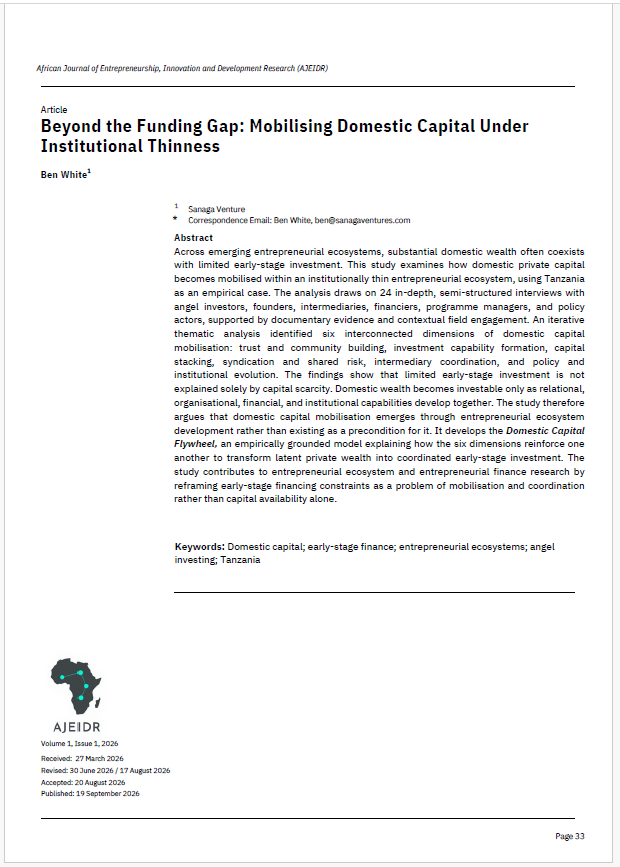
Across emerging entrepreneurial ecosystems, substantial domestic wealth often coexists with limited early-stage investment. This study examines how domestic private capital becomes mobilised within an institutionally thin entrepreneurial ecosystem, using Tanzania as an empirical case. The analysis draws on 24 in-depth, semi-structured interviews with angel investors, founders, intermediaries, financiers, programme managers, and policy actors, supported by documentary evidence and contextual field engagement. An iterative thematic analysis identified six interconnected dimensions of domestic capital mobilisation: trust and community building, investment capability formation, capital stacking, syndication and shared risk, intermediary coordination, and policy and institutional evolution. The findings show that limited early-stage investment is not explained solely by capital scarcity. Domestic wealth becomes investable only as relational, organisational, financial, and institutional capabilities develop together. The study therefore argues that domestic capital mobilisation emerges through entrepreneurial ecosystem development rather than existing as a precondition for it. It develops the Domestic Capital Flywheel, an empirically grounded model explaining how the six dimensions reinforce one another to transform latent private wealth into coordinated early-stage investment. The study contributes to entrepreneurial ecosystem and entrepreneurial finance research by reframing early-stage financing constraints as a problem of mobilisation and coordination rather than capital availability alone.
References
Acs, Z. J., Autio, E., & Szerb, L. (2014). National systems of entrepreneurship: Measurement issues and policy implications. Research Policy, 43(3), 476–494. https://doi.org/10.1016/j.respol.2013.08.016
Africa: The Big Deal. (2024). Startup funding database. Retrieved from https://thebigdeal.substack.com/p/2025ir2
Ahlstrom, D., & Bruton, G. D. (2006). Venture capital in emerging economies: Networks and institutional change. Entrepreneurship Theory and Practice, 30(2), 299–320. https://doi.org/10.1111/j.1540-6520.2006.00122.x
Barder, O. (2012). Can aid work? Center for Global Development. https://www.cgdev.org/publication/can-aid-work-written-testimony-submitted-house-lords
Biancalani, F., Czarnitzki, D., & Riccaboni, M. (2022). The Italian Start Up Act: A microeconometric program evaluation. Small Business Economics, 58(3), 1699–1720. https://doi.org/10.1007/s11187-021-00468-7
Bruton, G. D., Fried, V. H., & Manigart, S. (2005). Institutional influences on the worldwide expansion of venture capital. Entrepreneurship Theory and Practice, 29(6), 737–760. https://doi.org/10.1111/j.1540-6520.2005.00106.x
Colonnelli, E., Cruz, M., Pereira-Lopez, M., Porzio, T. & Zhao, C. (2026). Startups in Africa. Working Paper No. w35261. National Bureau of Economic Research. https://www.nber.org/system/files/working_papers/w35261/w35261.pdf
DEG Impulse. (2022). Final evaluation report: develoPPP Ventures programme overview. Deutsche Investitions- und Entwicklungsgesellschaft. https://www.degimpulse.de/documents/Final-Report_VenturesEvaluation_final.pdf
Efino Consulting. (2024). Unlocking startup capital: Tanzania angel investment landscape feasibility study report. https://cdn.prod.website-files.com/67d40b98199a4e774f7d01d0/6809dfb93b3c824314581c38_TAA%20Feasibility%20Report%202024.pdf
Freear, J., Sohl, J. E., & Wetzel, W. E. (1994). Angels and non-angels: Are there differences? Journal of Business Venturing, 9(2), 109–123. https://doi.org/10.1016/0883-9026(94)90004-3
Giraudo, E., Giudici, G., & Grilli, L. (2019). Entrepreneurship policy and the financing of young innovative companies: Evidence from the Italian Startup Act. Research Policy, 48(9), 103801. https://doi.org/10.1016/j.respol.2019.05.010
Gompers, P., & Lerner, J. (2001). The venture capital revolution. Journal of Economic Perspectives, 15(2), 145–168. https://doi.org/10.1257/jep.15.2.145
Granovetter, M. (1985). Economic action and social structure: The problem of embeddedness. American Journal of Sociology, 91(3), 481–510. https://doi.org/10.1086/228311
Hall, B. H., & Lerner, J. (2010). The financing of R&D and innovation. NBER Working Paper No. 15325. https://doi.org/10.3386/w15325
Hausmann, R., & Rodrik, D. (2003). Economic development as self-discovery. Journal of Development Economics, 72(2), 603–633. https://doi.org/10.1016/S0304-3878(03)00124-X
Henley & Partners, & New World Wealth. (2025). Africa wealth report 2025. Henley & Partners. https://www.henleyglobal.com/publications/africa-wealth-report-2025
Herrington, M., & Coduras, A. (2019). The national entrepreneurship framework conditions in sub-Saharan Africa: A comparative study of GEM data/National Expert Surveys for South Africa, Angola, Mozambique and Madagascar. Journal of Global Entrepreneurship Research, 9(1), 60. https://doi.org/10.1186/s40497-019-0183-1
Hess, S., Wahl, A., & Johnson, A. R. (2025). Measuring entrepreneurial ecosystems across levels: a district approach. Small Business Economics, 1-33. https://doi.org/10.1007/s11187-025-01041-2
International Finance Corporation. (2023). Venture capital and the rise of Africa’s tech startups. World Bank Group. https://www.ifc.org/en/insights-reports/2025/venture-capital-and-the-rise-of-africa-s-tech-startups
Isenberg, D. J. (2010). How to start an entrepreneurial revolution. Harvard Business Review, 88(6), 40–50. https://hbr.org/2010/06/the-big-idea-how-to-start-an-entrepreneurial-revolution
Kahneman, D., & Tversky, A. (1979). Prospect theory: An analysis of decision under risk. Econometrica, 47(2), 263–291. https://doi.org/10.2307/1914185
Kaplan, S. N., & Strömberg, P. (2004). Characteristics, contracts, and actions: Evidence from venture capitalist analyses. Journal of Finance, 59(5), 2177–2210. https://doi.org/10.1111/j.1540-6261.2004.00696.x
Kerr, W. R., Lerner, J., & Schoar, A. (2014). The consequences of entrepreneurial finance: Evidence from angel financings. Review of Financial Studies, 27(1), 20–55. https://doi.org/10.1093/rfs/hhr098
Lerner, J. (1994). The syndication of venture capital investments. Financial Management, 23(3), 16–27. https://10.1016/S0305-0483(01)00024-X
Lerner, J. (2009). Boulevard of broken dreams: Why public efforts to boost entrepreneurship and venture capital have failed—and what to do about it. Princeton University Press. https://doi.org/10.1515/9781400831630
Lerner, J., & Nanda, R. (2020). Venture capital’s role in financing innovation: What we know and how much we still need to learn. Journal of Economic Perspectives, 34(3), 237–261. https://doi.org/10.1257/jep.34.3.237
Sahlman, W. A. (1990). The structure and governance of venture-capital organisations. Journal of Financial Economics, 27(2), 473–521. https://doi.org/10.1016/0304-405X(90)90065-8
Saxenian, A., & Sabel, C. (2008). Venture capital in the “periphery”: The new argonauts, global search, and local institution building. Economic Geography, 84(4), 379–394. https://doi.org/10.1111/j.1944-8287.2008.00001.x
Stam, E. (2015). Entrepreneurial ecosystems and regional policy: A sympathetic critique. European Planning Studies, 23(9), 1759–1769. https://doi.org/10.1080/09654313.2015.1061484
Stam, E., Nkontwana, P., McDonald, R., Murenzi, R., Addo, K. A., Bayuo, B., Baah, B., Riezebos, S. & Gelissen, T. (2026). Measuring National Entrepreneurial Ecosystems in Africa. World Development, 202: 107357. https://doi.org/10.1016/j.worlddev.2026.107357
Stam, E., & Van de Ven, A. (2021). Entrepreneurial ecosystem elements. Small Business Economics, 56(2), 809–832. https://doi.org/10.1007/s11187-019-00270-6
Stever, J. (2023). When bottom-up and top-down meet: The ADDIS process and the co-creation of the Nigeria Startup Bill. In S. Boucher, C. A. Hallin, & L. Paulson (Eds.), The Routledge handbook of collective intelligence for democracy and governance (pp. 222–233). Routledge. https://doi.org/10.4324/9781003215929-16
Tanzania Startup Association. (2024). Tanzania Startup Ecosystem Status Report, 2024. https://tsa.co.tz/storage/documents/w9Fsk1RQDCUKtfNiUXxOGijbCajKBHeuB8SNKwxx.pdf
Team Europe Initiative – Investing in Young Businesses in Africa (IYBA). (2025). S-BAN impact assessment report. European Commission. https://iyba-seed.eu/en/impact-assessment-of-the-specialised-angel-investment-training-in-the-context-of-tanzania-business
Tony Blair Institute for Global Change. (2022). Supercharging Africa’s Startups: The Continent’s Path to Tech Excellence. London, UK: TBI Publications. https://institute.global/insights/tech-and-digitalisation/supercharging-africas-startups-continents-path-tech-excellence
United Nations Capital Development Fund (UNCDF). (2022). Building inclusive digital economies in Tanzania: Annual impact and results. New York, NY: United Nations. Retrieved from https://www.uncdf.org/article/7733/building-inclusive-digital-economies-in-tanzania
Wurth, B., Stam, E. & Spigel, B. (2022) Toward an Entrepreneurial Ecosystem Research Program. Entrepreneurship Theory & Practice. 46.3: 729-778. https://doi.org/10.1177/1042258721998948
Wurth, B., Stam, E. & Spigel, B. (2023) Entrepreneurial Ecosystem Mechanisms. Foundations and Trends in Entrepreneurship 19.3: 224-345. http://dx.doi.org/10.1561/0300000089
Downloads
Published
Issue
Section
License
Copyright (c) 2026 Ben White (Author)

This work is licensed under a Creative Commons Attribution 4.0 International License.