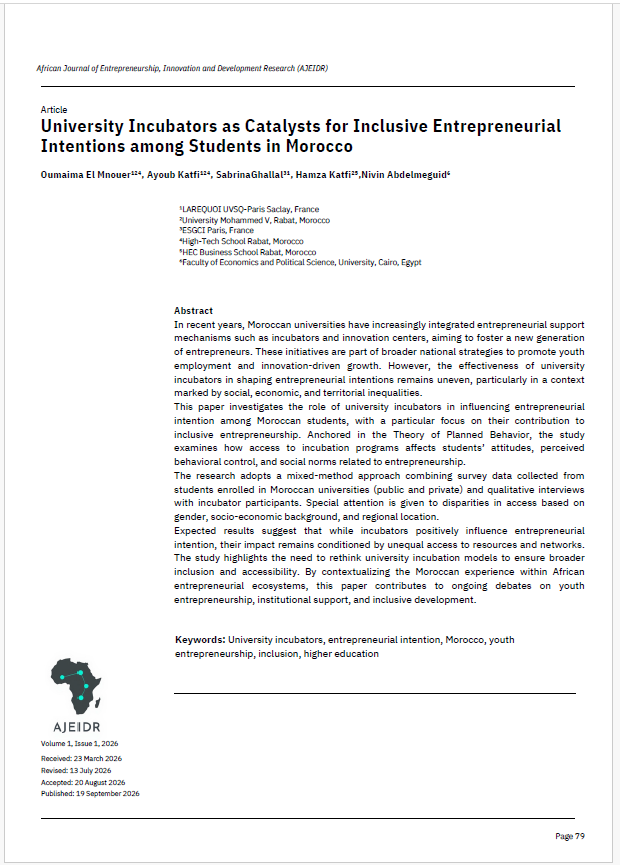
University Incubators as Catalysts for Inclusive Entrepreneurial Intentions among Students in Morocco
Keywords:
University Incubators, Entrepreneurial Intention, Morocco, Youth Entrepreneurship, Inclusion, Higher EducationAbstract
In recent years, Moroccan universities have increasingly integrated entrepreneurial support mechanisms such as incubators and innovation centres, aiming to foster a new generation of entrepreneurs. These initiatives are part of broader national strategies to promote youth employment and innovation-driven growth. However, the effectiveness of university incubators in shaping entrepreneurial intentions remains uneven, particularly in a context marked by social, economic, and territorial inequalities. This paper investigates the role of university incubators in influencing entrepreneurial intention among Moroccan students, with a particular focus on their contribution to inclusive entrepreneurship. Anchored in the Theory of Planned Behaviour, the study examines how access to incubation programmes affects students’ attitudes, perceived behavioural control, and social norms related to entrepreneurship. The research adopts a mixed-method approach combining survey data collected from students enrolled in Moroccan universities (public and private) and qualitative interviews with incubator participants. Special attention is given to disparities in access based on gender, socio-economic background, and regional location. Expected results suggest that while incubators positively influence entrepreneurial intention, their impact remains conditioned by unequal access to resources and networks. The study highlights the need to rethink university incubation models to ensure broader inclusion and accessibility. By contextualising the Moroccan experience within African entrepreneurial ecosystems, this paper contributes to ongoing debates on youth entrepreneurship, institutional support, and inclusive development.
References
Ajzen, I. (1991). The theory of planned behaviour. Organizational Behavior and Human Decision Processes, 50(2), 179-211.
Braun, V., & Clarke, V. (2006). Using thematic analysis in psychology. Qualitative Research in Psychology, 3(2), 77-101. Brunner, P., & Schaeffer, V. (2025). Which actors provide which resources to student entrepreneurs in entrepreneurial ecosystems? In P. Baig et al. (Eds.), Entrepreneurial Ecosystems: Resource Acquisition, Flow and Management (pp. 67-82). Springer.
High Commission for Planning (HCP). (2024). Labor market indicators 2024. Rabat: HCP.
Kolvereid, L. (1996). Organisational employment versus self-employment: Reasons for career choice intentions. Entrepreneurship Theory and Practice, 20(3), 23-31.
Mouazen, A. M., & Hernández-Lara, A. B. (2023). Entrepreneurial ecosystem, gig economy practices and women's entrepreneurship: the case of Lebanon. International Journal of Gender and Entrepreneurship, 15(3), 249-274.
Souitaris, V., Zerbinati, S., & Al-Laham, A. (2007). Do entrepreneurship programmes raise entrepreneurial intention of science and engineering students? The effect of learning, inspiration and resources. Journal of Business Venturing, 22(4), 566-591.
Wood, A. J., Graham, M., Lehdonvirta, V., & Hjorth, I. (2018). Good gig, bad gig: Autonomy and algorithmic control in the global gig economy. Work, Employment and Society, 33(1), 56-75.
Downloads
Published
Issue
Section
License
Copyright (c) 2026 Oumaima El Mnouer, Ayoub Katfi, Sabrina Ghallal, Hamza Katfi, Nivin Abdelmeguid (Author)

This work is licensed under a Creative Commons Attribution 4.0 International License.